No products available yet

Stay tuned! More products will be shown here as they are added.

Professional stainless steel sinks for catering kitchens

The stainless steel sink is the central washing station of any professional kitchen. Built to withstand constant water, detergents and knocks, it handles the pre-washing of crockery, the cleaning of gastronorm pans, utensils and cookware. Our range gathers 33 references from Diverso, Diamond and Vogue, in AISI 304 or 430 stainless steel depending on the model, priced from €500 to €4,404 incl. VAT. Single or double bowl, with a left or right drainer, with upstand, under-shelf or a dedicated dishwasher space: you will find here the configuration suited to your washing area, whether for a small bar, a restaurant or a catering kitchen.

AISI 304 or AISI 430 stainless steel: the right choice for a wet area

The sink is the most water-exposed element in the whole kitchen, which makes steel quality decisive. AISI 304, austenitic (around 18% chromium and 8 to 10% nickel), offers the best corrosion resistance against constant water, salt and washing products: it is the reference grade for bowls and tops in permanent contact with water. AISI 430, ferritic and nickel-free, more economical, is used on less exposed parts such as legs or lower shelves. Seamless pressed bowls and rounded corners limit dirt retention and make cleaning easier, two essential assets in an area subject to strict hygiene controls.

One or two bowls, left or right drainer

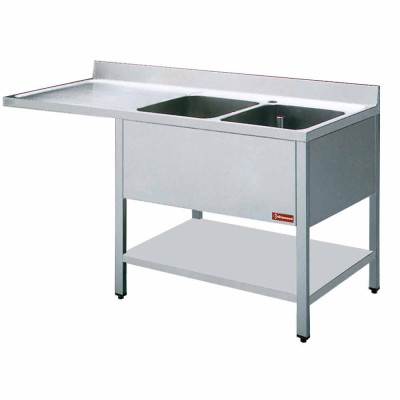
The number of bowls depends on your washing volume and method. The single-bowl sink suits small spaces and auxiliary washing. The double-bowl sink allows a wash-then-rinse cycle, or task separation, and becomes essential as throughput rises. The drainer position, left or right, is chosen according to the flow direction of your washing line and the dishwasher location: a well-oriented drainer smooths the path from dirty to clean. To target the right configuration immediately, use the Number of bowls, Drainer side and Length (cm) filters available on this page.

Upstand, under-shelf and dishwasher space

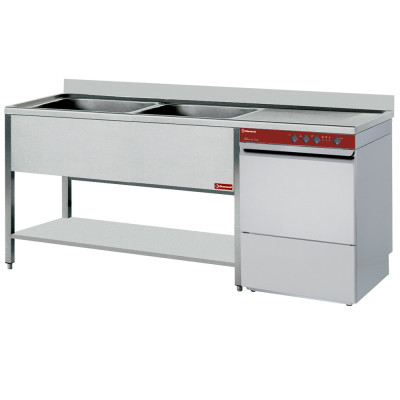
Several options adapt the sink to your station. The rear upstand prevents water splashes from passing behind the unit and protects the wall. The lower under-shelf provides storage for pans and products. Some sinks reserve a dishwasher space for a hood machine, allowing it to be integrated directly into the washing line. Finally, our sink + dishwasher sets combine the matching sink and dishwasher in a single reference, for a complete and coherent washing station.

Choosing the right dimensions

The length of the sink governs the draining surface and working comfort; our range runs from compact models up to large sinks of over 2 metres. The standard 700 mm depth offers spacious bowls, while 600 mm versions suit reduced spaces. The working height, around 850 to 900 mm including adjustable feet, respects the ergonomics of a standing station and is levelled on the floor with feet adjusters. Remember to plan water supply and drainage nearby, along with enough room for pan circulation.

Our stainless steel sink brands

Diverso offers single and double-bowl sinks at the best value for money, in welded or demountable-leg versions. Diamond covers a wide range of configurations: one or two bowls, left or right drainer, upstand, under-shelf and dishwasher space, in many dimensions. Vogue rounds out the offer with sinks in varied formats, single or double bowl, ideal for small and medium washing stations. This diversity lets you compose a washing area perfectly suited to your kitchen.

A few models from the range

Washing station: combining sink and dishwasher

An efficient washing station usually combines several elements. Upstream, an inlet table receives the dirty crockery and allows sorting and waste scraping. The sink then handles pre-washing and soaking of the most soiled items, while the dishwasher takes care of high-temperature washing. Downstream, an outlet table holds the clean crockery while it dries. Depending on the size of your establishment, you may choose a standalone sink, a double-bowl sink acting as wash and rinse, or a set integrating the dishwasher directly. The key is to respect a single flow direction, with no going back, to avoid cross-contamination between dirty and clean.

Which sink for your establishment?

Needs vary widely from one kitchen to another. A bar or café will often be content with a compact single-bowl sink for glasses and cups, supplemented by a glasswasher. A restaurant will prefer a double-bowl sink with a generous drainer, or even a dishwasher space, to absorb service rushes. A catering kitchen or lab will aim for large sinks over 1.80 m, sturdy and deep, able to hold gastronorm pans and trays. In all cases, the length available along the wall and the position of the water supplies guide the final choice.

Hygiene, HACCP and maintenance

The sink plays a key role in the hygiene chain. Stainless steel bowls, smooth and non-porous, disinfect easily and retain neither odours nor bacteria. To maintain them, clean with warm water and a neutral detergent, without steel wool or unrinsed chlorinated products that would attack the steel's passive layer; rinse and dry in the direction of the grain. Regularly check the waste, overflow and trap to avoid stagnation. A clean, well-organised washing station is a pillar of HACCP compliance and forward flow.

Installation and washing-area layout

The sink area is organised on the forward-flow principle, clearly separating the dirty-crockery circuit from the clean one. Pair your sink with stainless work tables for plating areas, stainless wall shelves for overhead storage, stainless hand wash basins required by hygiene rules, and suitable taps & spray heads for rinsing. Everything is grouped in the stainless steel furniture category.

Build quality and finish

Beyond the steel grade, the quality of a sink is judged by the thickness of the sheet metal, the depth and shape of the bowls, and the surface finish. A brushed grain limits fingerprints and micro-scratches and keeps a clean appearance over time. Reinforced tops do not flex under load, and welds that are ground flush leave no sharp edges or retention points. Deep bowls reduce splashing and accommodate tall pots and gastronorm pans, while a well-sized drainer lets water run back into the bowl rather than onto the floor. These details, often invisible at first glance, make the daily difference between a sink that lasts and one that ages quickly.

FAQ — Stainless steel sinks

One or two bowls? One bowl is enough for auxiliary washing or a small space; two bowls allow wash and rinse to be separated and suit higher throughput.

Left or right drainer? Choose the side according to the flow direction of your sink and the dishwasher position, for a smooth path from dirty to clean.

Do I need an upstand? The upstand is recommended when the sink sits against a wall: it blocks water splashes and makes cleaning easier.

Which bowl depth? A 700 mm depth offers more spacious bowls; 600 mm suits reduced spaces.

AISI 304 or 430? AISI 304 is advised for bowls and tops in permanent contact with water; AISI 430 suits less exposed structural parts.

Welded or demountable? The welded-leg version is more rigid and delivered assembled; the demountable version transports and stores flat, handy for difficult access.

Taps and accessories

A sink is only complete with suitable taps. High-spout mixer taps, spring-loaded pre-rinse spray heads and wall-mounted taps make rinsing large containers easier. Also consider the waste, overflow and trap, which ensure reliable drainage and limit odours. To equip your sink, browse our selection of taps & spray heads designed for intensive use in professional kitchens. Pairing the right tap with the right bowl configuration significantly improves the speed and comfort of your washing station, especially during service rushes when every second counts.

Are the feet adjustable? Most sinks have levelling feet that compensate for uneven floors and adjust the working height for perfect stability.

How do I maintain the bowls? Empty and rinse the bowls after each service, descale periodically and check the waste and trap to ensure drainage without stagnation or odour.

Can I integrate a dishwasher? Yes, some sinks provide a dedicated space for a hood machine, and our sets combine a matching sink and dishwasher in one reference.

What length should I choose? Measure the wall space available and the position of water supplies; our range runs from compact units to large sinks of more than two metres for high-volume kitchens.

Is stainless steel hard to keep clean? On the contrary: its smooth, non-porous surface wipes down quickly, resists odours and bacteria, and only requires a neutral detergent and a soft cloth for daily care.

This website uses cookies to ensure you get the best experience on our website