No products available yet
Stay tuned! More products will be shown here as they are added.
Water osmosis units provide the most advanced water treatment in a professional kitchen. Through reverse osmosis, they strip the water of almost all its dissolved minerals, for a result that neither a simple filter nor a water softener can achieve: glasses of absolute clarity, without the slightest drying mark. Frigo Horeca offers Diamond stainless steel monobloc osmosis units, designed to feed glasswashers and dishwashers and guarantee impeccable water quality.
An osmosis unit relies on the principle of reverse osmosis. Under pressure, water passes through a semi-permeable membrane whose pores are so fine that they let only water molecules through, retaining mineral salts, limescale and impurities. The water that comes out is called "osmosed": almost pure, it no longer deposits anything as it dries. It is the benchmark technology when very high water purity is sought.
It is essential to distinguish the two treatments. The softener exchanges calcium and magnesium for sodium: it prevents scaling but leaves the water mineralised. The osmosis unit removes almost all minerals: the water becomes pure and leaves no residue as it dries. The softener protects machines; the osmosis unit goes further by also guaranteeing perfect shine. The two can complement each other, the softener protecting the osmosis membrane.
Beyond washing machines, osmosed water benefits several stations: glasswashers for perfect clarity, but also coffee machines and steam ovens, sensitive to taste and limescale. Pure water improves the quality of hot drinks and durably protects hot-water equipment. For a cocktail bar or an upmarket establishment, it is an investment that enhances every service.
Our models produce 150 litres of osmosed water per hour, a flow rate calibrated to continuously feed a professional glasswasher or dishwasher during service. This flow ensures the machine never runs short of treated water, even at sustained pace, while remaining compact. Sizing depends on the number and type of appliances to feed; our team will guide you according to your installation.
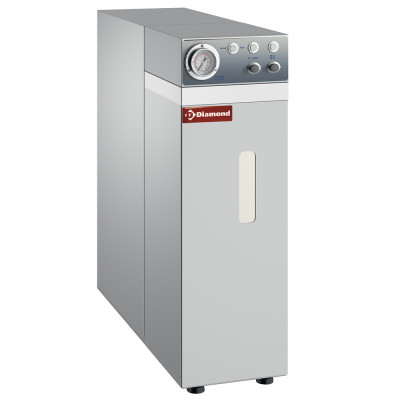
Diamond osmosis units are designed as monoblocs: membrane, prefilters and connections are combined in a compact, robust unit. The stainless steel construction withstands constant humidity and eases integration into the wash area or near the machines. The monobloc format simplifies installation and maintenance compared with separate elements.
Some models, such as the RS15/PP with expansion vessel, integrate a tank that stores osmosed water under pressure and delivers instant flow during demand peaks. The simpler RS15/AT model suits cases where continuous production is enough. The choice depends on the consumption profile: the expansion vessel provides a useful reserve for occasional, closely spaced demands.
The main visible benefit of osmosis is the total elimination of drying marks. Where water, even softened, can leave a faint film, osmosed water dries without depositing anything. Glasses come out brilliant and ready to serve, without the chore of manual wiping — which is itself a frequent source of marks and microbes. For premium glassware, it is a decisive advantage.
By removing limescale and minerals, osmosed water protects the heating elements, nozzles and circuits of the machines it feeds. Less scaling means fewer breakdowns, stable energy consumption and a longer service life. It is even more complete protection than that of a softener, particularly valuable in very hard-water regions.
The osmosis unit installs on the water supply, upstream of the machine to feed, and requires a drain connection for the reject water inherent to the process. We recommend installation by a professional, who will check the water pressure, the inlet water quality and correct sizing. A prefilter and, in very hard water, an upstream softener extend the membrane's life.
Maintaining an osmosis unit mainly involves periodically replacing the prefilters and, depending on use and water quality, the osmosis membrane. Regular checking of the produced water quality and pressure ensures optimal operation. Well maintained, an osmosis unit keeps its efficiency for years and continues to supply water of constant purity.
Reverse osmosis reverses the natural phenomenon of osmosis. Naturally, water migrates from a less concentrated solution towards a more concentrated one through a membrane. By applying a pressure higher than the osmotic pressure, the reverse movement is forced: water crosses the membrane, leaving behind the salts and impurities, which are flushed out with a fraction of the water known as "reject" water. The result is water of remarkable purity, whose mineral content is reduced by several tens of times compared with the inlet water.
In an establishment that cares about presentation, water quality shows right down to the glass. Osmosed water leaves no mark, which enhances drinks and glassware. But the benefit goes further: for coffee, controlled water better reveals the aromas; for steam ovens, it prevents scaling of the generators. The osmosis unit thus becomes a cross-cutting piece of equipment, serving washing, hot drinks and steam cooking alike.
The reverse osmosis process produces, alongside pure water, reject water that concentrates the retained minerals and goes to the drain. This reject is inherent to the technology. A well-sized, well-maintained osmosis unit optimises the ratio between produced and rejected water. A drain connection is therefore essential, and it should be taken into account during installation to ensure clean, compliant operation.
The osmosis unit is aimed primarily at establishments where drink presentation is essential: cocktail bars, brasseries, hotels, fine-dining restaurants. It is particularly relevant in hard-water regions, where softening alone is not enough to obtain perfect glasses. Paired with a glasswasher, it transforms the look of the glassware; paired with a dishwasher, it improves drying and protects the machine.
The right choice depends on the volume of treated water needed, the number of appliances fed and the consumption profile. A flow rate of 150 litres/hour covers the needs of a glasswasher or dishwasher in continuous service. For occasional, intense demands, a model with an expansion vessel provides a pressurised reserve. If in doubt, send us your configuration: we will guide you towards the right model.
The stainless steel monobloc construction ensures the robustness of the unit in the humid environment of the wash area. Stainless does not corrode, cleans easily and withstands intensive long-term use. Combined with regular maintenance of the prefilters and membrane, it gives the osmosis unit a longevity that makes it a profitable investment, paid back by the constant water quality and the protection it brings to downstream equipment.
The osmosis unit comes into its own when integrated into a coherent treatment chain. Upstream, a prefilter retains particles and a softener protects the membrane from limescale; the osmosis unit then refines the water to the desired purity. This staged approach extends the life of each element and ensures stable water quality. Thinking of water treatment as a whole, rather than as an isolated appliance, is the key to a durable result and a controlled maintenance cost.
While an osmosis unit represents a more significant initial outlay than a simple filter, it pays back over time. Spotless glassware enhances the establishment's image and removes the labour of manual wiping; protected machines break down less and last longer; coffee and steam equipment keep performing. For establishments where presentation and equipment reliability matter, the osmosis unit is less an expense than a long-term investment in quality, consistency and peace of mind across the whole washing and beverage operation.
What is the difference between an osmosis unit and a softener?
The softener removes limescale by exchanging calcium and magnesium for sodium; the osmosis unit removes almost all minerals for pure water that leaves no mark as it dries.
Why install an osmosis unit on a glasswasher?
To obtain glasses of absolute clarity, with no drying marks and no wiping — a result that softening alone cannot achieve.
What flow rate?
Our models produce 150 litres/hour, enough to continuously feed a professional glasswasher or dishwasher.
What is the expansion vessel for?
It stores osmosed water under pressure to deliver instant flow during demand peaks, as on the RS15/PP model.
Do I also need a softener?
In very hard water, an upstream softener protects the osmosis membrane and extends its life. The two treatments are complementary.
Is maintenance demanding?
It is limited to periodically replacing the prefilters and membrane, and checking water quality and pressure.
Does an osmosis unit need a drain connection?
Yes. The reverse osmosis process produces reject water that carries away the retained minerals, so a connection to a drain is required and should be planned at installation.
Whether for a cocktail bar chasing flawless glasses or a kitchen protecting its equipment from very hard water, an osmosis unit delivers a level of purity that completes the washing line. Discover the full Washing range from Frigo Horeca.