
No products available yet

Stay tuned! More products will be shown here as they are added.

Professional bar fridge: the essential service equipment behind your counter

The professional bar fridge is the central piece of any bar, café, restaurant or hotel installation. Behind the counter, it makes cold drinks available to your team for direct service: beers, soft drinks, water, juices, white wines, champagnes. Well designed, it combines refrigeration performance, immediate accessibility, customer visibility and resistance to intensive use. A bad choice is paid for in excessive energy consumption, time lost rummaging through a poorly organised cabinet, and degraded image facing customers.

At Frigo Horeca, we offer a complete range of commercial bar fridges covering all configurations: 1, 2, 3 or 4 doors, glass or solid, sliding or hinged, not forgetting Polar back bars with drawers and dedicated compartments. This page brings together everything you need to know to choose the bar fridge suited to your business, understand the differences between configurations, and make the most of your space.

Why invest in a professional bar fridge?

A professional bar fridge is not a simple refrigerator brought to counter height. It is specifically designed to withstand the ultra-frequent door openings of bar service (up to 100-200 openings per evening), to maintain a stable temperature despite this traffic, and to fit ergonomically into a workstation.

The counter height (generally 85-90 cm) is the sector standard: it allows the barman to grab a bottle without bending and without interrupting service. Internal shelves are positioned to optimise vertical bottle storage, and doors (glass or solid) are equipped with reinforced seals to limit thermal losses despite frequency of use.

The other key advantage is the commercial visibility that glass doors allow: the customer sees immediately what is available, which stimulates impulse consumption. For displayed beers and soft drinks, it is a direct factor in turnover.

In which establishments should you install a bar fridge?

All bars are equipped with a bar fridge: bistro, brasserie, pub, cocktail bar, club, café. The size obviously varies according to activity volume, but the principle remains identical. The 2-door bar fridge is the minimum format for an average bar, 3 or 4 doors become necessary beyond that.

In restaurants, the bar fridge finds its place for white wines and champagnes in service, soft drinks, sparkling water. It is also the natural complement to an ice machine that provides ice for cocktails and wines.

In hotels, bar fridges are found in all service areas: lobby bar, room mini-bars, seminar spaces. For rooms, the dedicated minibar fridge is more appropriate.

For snack bars, chip shops and sandwich shops, the glass-door bar fridge serves both as storage and presentation: soft drinks, water, juices within reach of the customer in self-service. The natural complement remains vertical drinks fridges for larger volumes.

Finally, high-end bars and premium hotels often integrate a back bar with drawers and specialised compartments: perfect bottle presentation, separate storage of glasses and accessories, refined aesthetic finish.

How to choose your professional bar fridge

Number of doors and capacity

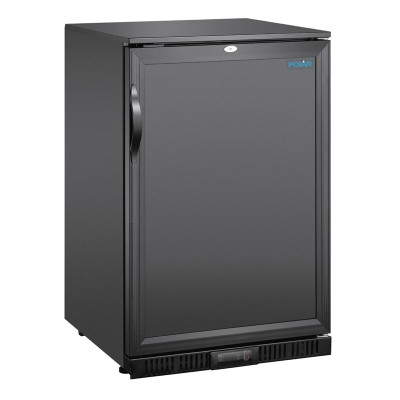
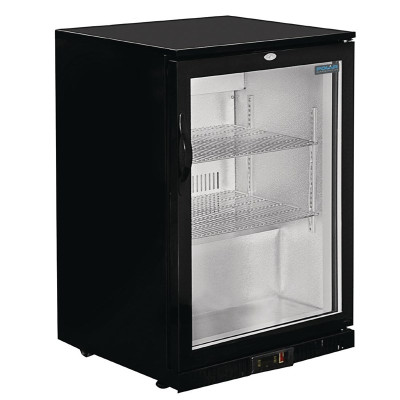
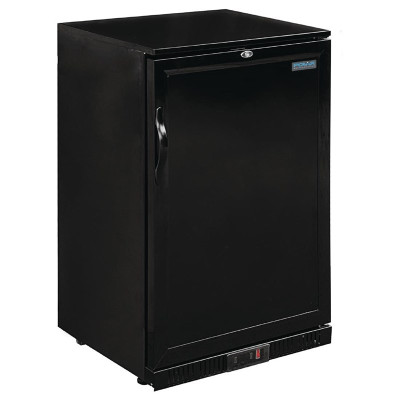
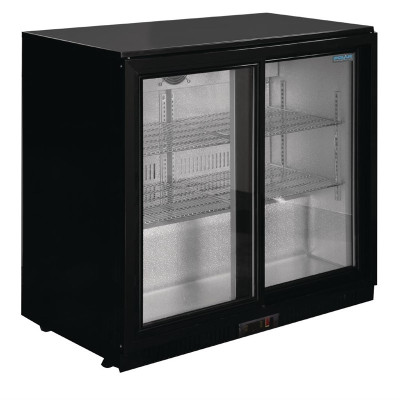
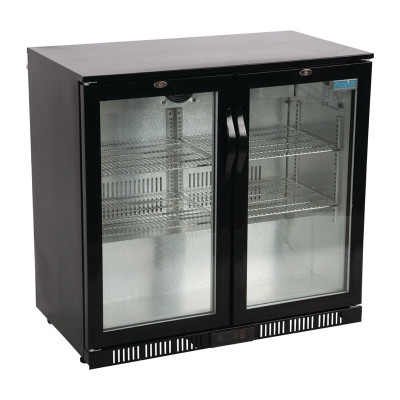
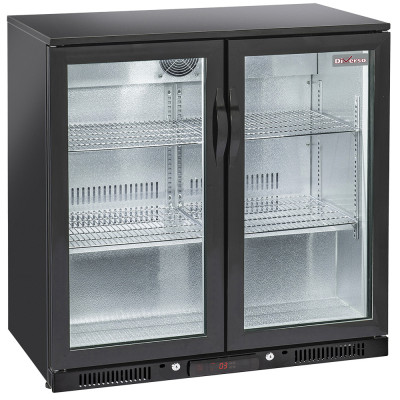
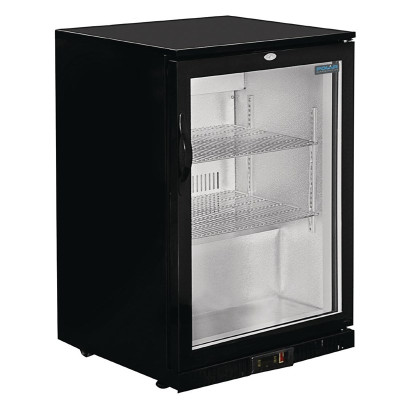
The choice of door number depends directly on service volume and available space. The 1-door bar fridge, like the 1-door glass bar fridge, suits small bars or as a specialised complement (wine cellar, dedicated champagne fridge). The 2-door bar fridge is the market standard: 2-door bar fridge 208 litres for small bars, 2-glass-door bar fridge 375 litres for bistros and brasseries.

Beyond that, the 3-door bar fridge like the 3-door bar fridge 579 litres covers the needs of high-throughput bars. And the 4-door bar fridge, like the 4-glass-door bar fridge 783 litres, is reserved for large bars, volume brasseries or kitchens with permanent service.

Solid, glass, hinged or sliding doors

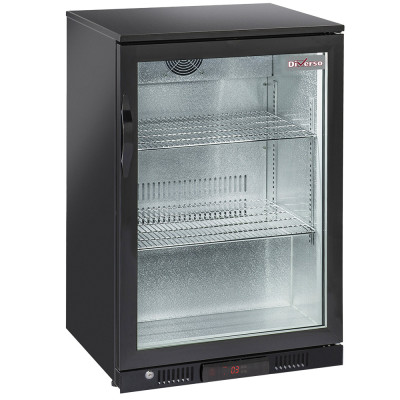
The glass doors highlight the contents and encourage impulse buying on the customer side. They consume slightly more energy (less insulating than solid doors) but transform the fridge into a presentation element. Ideal when the customer can see the fridge, for example in self-service or in a visible bar.

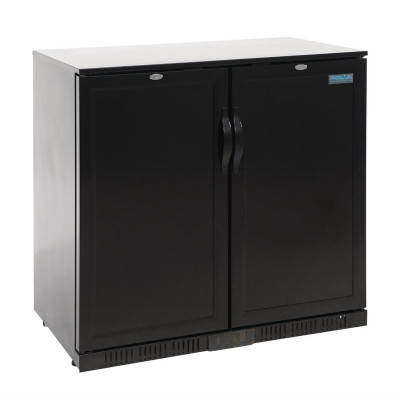
The solid doors are more insulating and therefore more economical. They are used when the fridge is out of customer sight or when you want to limit visual appeal (back bar storage fridges, for example).

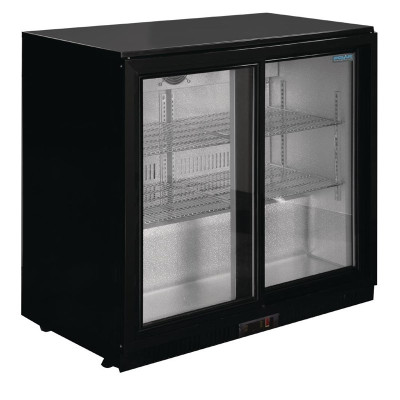
The sliding doors, as on the 2-door sliding bar fridge or the 3-door sliding bar fridge 330 litres, are perfect when space in front of the fridge is limited: no swing, quick access, and better passage in the service area. It is the recommended choice for narrow bars or with a circulation flow behind the counter.

The standard hinged doors remain the most economical and suit 80% of installations.

Back bar with drawers or dedicated compartments

For high-end service or refined design, Polar back bars offer specialised configurations:

Refrigeration performance and consumption

Check the target temperature (generally +2°C to +8°C in standard bar fridge) and energy class. Recent models with R600a or R290 gas and energy class D or better are to be preferred: savings on the bill and guaranteed F-Gas regulatory compliance.

For very high-rotation bars, also check the temperature recovery capacity after opening — an often-neglected criterion that can make the difference between fluid service and a constantly running compressor.

Installation and maintenance of a bar fridge

The installation of a stainless steel bar fridge requires a standard 220-240 V electrical socket and sufficient ventilation space around the refrigeration unit. Modern models are designed to fit perfectly in back-counter, with front ventilation that avoids having to leave space at the back.

Daily maintenance comes down to exterior and interior cleaning, checking door seals (often damaged due to frequent openings), and dusting the ventilation grille. In case of defective seal, replace it quickly: consumption can double in a few days.

For glass door models, regularly clean the interior and exterior glass to preserve visual appeal and transparency — this is precisely what justifies choosing a glass door.

Which bar fridge for which establishment?

Small bar, bistro, neighbourhood café

A 2-hinged-solid-door bar fridge is enough for classic service. The bar fridge with 2 hinged doors is a good robust and economical entry-level model.

Cocktail bar and lounge

Prefer a 3 or 4 glass-door bar fridge to highlight the collection of spirits, wines and exceptional beers. The 3-glass-door bar fridge 579 litres is perfect for this context. Add a Polar back bar with drawers for premium bottles.

Brasserie and large restaurant

Opt for a high-capacity 4-door bar fridge, possibly complemented by a drawer back bar with wine cooler. Think about the complete ecosystem with your ice machine and your vertical drinks fridges for storage.

Snack bar, chip shop, sandwich shop

Glass-door bar fridge (1 or 2 doors) in self-service facing the customer, complemented by a drinks dispenser for tap soft drinks.

Our selection of professional bar fridges

Buying the right professional bar fridge

The bar fridge is the most solicited equipment in your bar: permanent openings, intense stress during services. Some rules for buying well:

Choose a recognised professional brand (Polar and other horeca references). Mass-market models do not last more than 2-3 years in professional bar use: unavailable spare parts, seals that fail quickly, undersized compressors.

Adapt the door configuration to your real service flow: sliding if space in front is limited, glass if you want commercial visibility, solid hinged if you prioritise insulation and energy savings.

Think about the complete bar ecosystem: your bar fridge works with your ice machine, your vertical drinks fridges for storage, your drinks dispensers for tap soft drinks, and possibly your water fountains. The coherence of these equipments determines the fluidity of your service.

Finally check the commercial warranty and the local after-sales service network. In a bar, a fridge breakdown in the middle of an evening is a major problem: a responsive after-sales service in Belgium makes all the difference.

This website uses cookies to ensure you get the best experience on our website