No products available yet
Stay tuned! More products will be shown here as they are added.
Water softeners are the silent guardians of any professional kitchen fitted with washing machines. By reducing water hardness, they protect dishwashers and glasswashers against limescale, extend their service life and guarantee a flawless wash result, free of marks and whitish deposits. Frigo Horeca offers a range of Diamond water softeners, from the compact monobloc model to the external-cylinder version for the largest volumes.
Mains water contains mineral salts, mainly calcium and magnesium, which are responsible for its hardness. The harder the water, the more it scales the equipment that heats it. In a professional kitchen where machines run continuously, this process accelerates and ends up degrading performance, increasing energy consumption and causing costly breakdowns. Softening the water upstream is the most effective preventive measure to protect your equipment.
When hard water is heated, limescale precipitates and deposits as scale on the walls, heating elements and rinse nozzles. A thin layer of scale is enough to significantly reduce heat transfer: the machine has to heat for longer to reach the same temperature, which increases the energy bill. Scale also clogs the nozzles, degrading rinse quality, and eventually damages the components. On glasses, it leaves that whitish film that can no longer be wiped away.
A water softener relies on the principle of ion exchange. Water passes through a resin loaded with sodium ions; in contact with this resin, the calcium and magnesium ions responsible for hardness are captured and replaced by sodium. The water that comes out is said to be "softened": it no longer scales the equipment. The resin volume, expressed in litres, determines the capacity of the unit: our models range from the 6-litre softener to the 60-litre external-cylinder model.
With use, the resin becomes saturated with calcium and must be regenerated. Regeneration consists of passing a brine (salt water) through the resin to flush out the limescale and recharge it with sodium. Chrono-volumetric softeners trigger this regeneration by combining two criteria: the elapsed time and the volume of water actually consumed. This mixed mode avoids regenerating too often during quiet periods and guarantees consistently softened water during busy periods, optimising salt and water use.
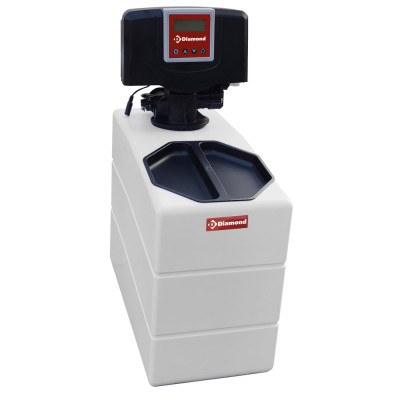
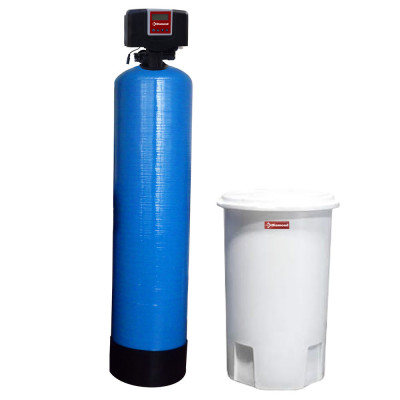
The monobloc models, such as the 6-litre and 8-litre, combine the resin and the salt tank in a single compact housing. They slide easily under a worktop or beside the machine and suit medium-sized installations. The 60-litre external-cylinder model separates the resin bottle from the salt tank: this configuration offers greater capacity and suits high-throughput kitchens where several machines draw on the same network.
The choice of capacity depends on local water hardness, the daily volume of water consumed and the number of machines to protect. An undersized capacity results in too-frequent regenerations and sometimes insufficiently softened water; an oversized capacity is an unnecessary extra cost. If in doubt, tell us your water hardness and consumption: the Frigo Horeca team will guide you towards the right model.
Softened water radically changes the result coming out of the machine. Glasses come out sparkling, with no film or marks, which is essential for a bar or brasserie that cares about presentation. Dishes dry more evenly and cleaning products work better, because limescale no longer neutralises part of them. As a result, you can often reduce the doses of detergent and rinse aid, which offsets part of the cost of the salt.
The softener is installed on the cold water supply, upstream of the machines to be protected. It requires a water connection, a drain for the regeneration water and, depending on the model, an electrical supply for the control valve. We recommend entrusting installation to a qualified fitter, who will set the unit according to the measured hardness and ensure compliance with sanitary rules. A bypass assembly makes maintenance easier without cutting off the establishment's water.
Maintaining a water softener is simple but regular. It essentially involves keeping the salt tank supplied with good-quality food-grade regeneration salt: without salt, the resin can no longer regenerate and the water becomes hard again. You should also periodically check that the regeneration cycles run correctly and disinfect the resin in line with the manufacturer's recommendations. A well-maintained unit keeps its efficiency for many years.
Installing a softener means protecting all your washing equipment in one move. Combined with the right washing accessories — dosers, pumps, tables — it forms the foundation of a reliable, economical dishwashing area. It is an investment that pays for itself through the savings in energy, products and repairs it generates.
Scale does not only increase the risk of breakdown: it weighs on the establishment's running costs every day. A scaled heating element uses more electricity to heat the water, cycles get longer and efficiency drops. To this are added technical call-outs, part replacements and, sometimes, the machine being out of service in the middle of a shift. Over the life of a dishwasher, the cumulative cost of these problems far exceeds that of a softener and its salt. Softening water is therefore first of all an economic decision: the unit pays for itself through the savings in energy, products and repairs it helps avoid, while securing service continuity.
While the dishwasher is the first concern, it is not the only equipment sensitive to limescale. Coffee machines, steam-injection ovens, kettles and percolators also suffer from scaling, which impairs their operation and, in the case of coffee, the taste of the drink. Installing a softener on the main water supply, or dedicated to a specific station, protects all of these appliances. For uses requiring even purer water, reverse osmosis complements softening; however, these two treatments meet distinct needs and do not replace one another.
It is useful to distinguish softening from other water treatments. A softener acts only on hardness, exchanging calcium and magnesium for sodium: it retains neither particles, nor tastes, nor any contaminants. To clarify the water, a pre-filter is added; to demineralise it thoroughly, reverse osmosis is used. Understanding what a softener does — and does not do — makes it possible to build the right treatment chain for the intended use, from protecting machines to the quality of drinks.
Several everyday signs reveal water that is too hard for your equipment. Glasses that come out of the machine with a persistent whitish film, dishes that dry with spots, heating elements furred with a hard white crust, longer cycles and rising energy bills are all symptoms of scaling. You may also notice scale building up around taps, nozzles and tank edges. When these signs appear, the limescale is already at work inside the machine, and the longer it is left, the harder and more costly it becomes to remove. Fitting a water softener upstream stops the process at the source and protects the investment that your washing machines represent, while restoring the clarity and shine your service depends on.
Why install a softener on a dishwasher?
To prevent scale from depositing on the heating elements and nozzles. This preserves performance, reduces energy use and avoids limescale marks on dishes and glasses.
What does "chrono-volumetric" mean?
It refers to a regeneration mode triggered both by elapsed time and by the volume of water consumed, which optimises salt and water use.
Which capacity should I choose?
It depends on water hardness and your consumption. The 6 and 8-litre models suit small installations; the 60-litre external-cylinder model is intended for high consumption.
What is the difference between monobloc and external cylinder?
The monobloc combines resin and salt tank in a single compact housing; the external-cylinder version separates the two to offer greater capacity.
Do I need to add salt?
Yes. The salt tank must stay supplied with regeneration salt: it is what allows the resin to recharge during each regeneration cycle.
Is softened water salty?
Ion exchange adds a small amount of sodium, generally imperceptible to taste for washing uses. The primary goal remains protecting the machines.
Does a softener reduce my product consumption?
Generally yes. As limescale neutralises part of the detergents, softened water often lets you reduce doses while improving the result.
Where should the softener be installed?
On the cold water supply, upstream of the machines it protects. A bypass assembly is recommended so maintenance can be carried out without cutting off the establishment's water supply.
Discover the full Washing range from Frigo Horeca to equip and protect your dishwashing area.