
Filter By

Capacity

Capacity

Cooling type (positive/negative)

Cooling type (positive/negative)

No products available yet

Stay tuned! More products will be shown here as they are added.

Professional chest freezer: the economical solution for long-term storage

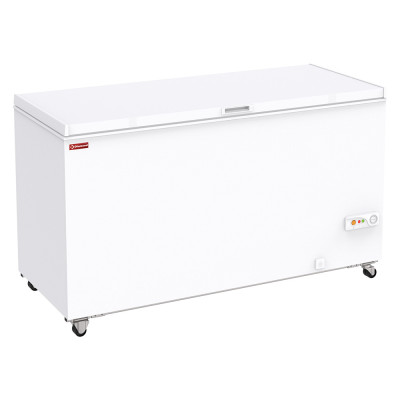
The professional chest freezer is the reference equipment for long-term storage of frozen products in large quantities. Its horizontal configuration with hinged or sliding lid offers several decisive advantages: better cold retention on opening (cold air being denser, it does not escape through the top), large useful storage capacity and reduced energy consumption compared to an equivalent vertical cabinet. It is the ideal equipment for butcheries, restaurants, hotels, caterers, but also food businesses and convenience stores that need to store meat, frozen vegetables, ice cream, prepared dishes and production bases durably.

At Frigo Horeca, we offer a complete range of commercial chest freezers in all capacities, from the compact 200 litres for a snack bar to 500 litres and more for collective kitchens. This page brings together everything you need to know to choose your stainless steel chest freezer or skinplate, understand the different types of lids, and optimise your installation for maximum durability.

Why invest in a professional chest freezer?

The chest freezer offers three structural advantages over the vertical cabinet:

First, the reduced energy consumption of 20 to 30% at equivalent capacity. On opening the lid, cold air (denser) stays in the chest, unlike a vertical cabinet where it escapes through the open door. This is a significant gain over 8-10 years of operation.

Then, the maximum useful capacity per cubic metre: no shelves or internal partitions reducing storage space. The chest accommodates voluminously and in bulk, which is perfect for meat pieces or blocks of frozen products.

Finally, reliability and longevity. The chest has simple mechanics (one compressor, one evaporator, no complex automatic defrost system), so fewer parts at risk of breakdown. Well maintained, a professional chest lasts 10 to 15 years versus 8 to 10 for an equivalent vertical cabinet.

In which establishments should you use a chest freezer?

Butcheries and meat wholesalers intensively use the chest to store large pieces and bulk purchases. The raw capacity and reduced consumption make it the ideal format to store meat for several months.

Restaurants and brasseries store fries, frozen desserts, bulk meats, long-term preparations in it. It is the ideal complement to a vertical freezer cabinet for daily mise en place.

Hotels and collectives mix chests and vertical cabinets: chests for long-term storage in reserve, vertical cabinets for daily kitchen service. For very large volumes, a negative cold room can take over.

Caterers and event services appreciate the chest to store preparations in advance, especially those to freeze quickly after a rapid cell freezer.

Convenience stores and food businesses often use a glass-lid chest freezer like the Polar G Series 200L glass chest freezer or the Polar G Series 270L glass chest freezer to display ice cream or frozen products in self-service facing customers.

How to choose your chest freezer

Useful capacity and footprint

Common capacities range from 200 to 500 litres for compact models, up to 700-800 litres for the largest. For standard horeca use, count:

Full hinged lid or sliding lids

The full hinged lid is the standard: a single lid that lifts in one piece, simple and economical. Ideal for small and medium capacity chests.

The sliding lids (generally by 2) allow accessing one half of the chest without disturbing the other. It is practical to gain vertical space above the chest and facilitate access in current loading. The 410-litre chest sliding lids on wheels illustrates this format.

Glass lid for direct sale

For direct retail sale, glass-lid models like the Polar G Series range offer indispensable visibility. It is the standard for ice cream, frozen products on customer-facing display, butcheries in direct sale.

Stainless steel or skinplate

The stainless steel chest is recommended for uses in professional kitchen or butchery: hygiene, resistance, aesthetics. White or grey skinplate suits uses in reserve or cellar, where visual appearance is secondary.

Installation, connection and maintenance

The chest freezer installs simply: standard 220-240 V electrical socket, ventilation space around the refrigeration unit. Prefer a location sheltered from sun and away from heat sources (oven, plate). For models on wheels, like the 410-litre chest with wheels, moving for floor cleaning is very simple.

Daily maintenance is minimal: cleaning the lid seal (tightness is crucial), dusting the ventilation grille, checking temperature. Once a year, a complete manual defrost remains recommended to avoid frost accumulation in corners.

On the energy side, prefer models in energy class D or better with R600a gas: the difference over 10 years can reach several hundred euros, and F-Gas compliance is guaranteed.

Our selection of chest freezers

Buying the right professional chest freezer

The chest freezer is probably the cold chain equipment with the longest lifespan (10 to 15 years). It is also the one that consumes the least per stored litre. Well chosen, it is a profitable long-term investment.

Imperatively choose a recognised professional brand (Polar, Diamond and other horeca references). Mass-market chests do not last in intensive use and their insulation is largely insufficient for commercial use.

Check the climate class: class 4 (30°C) for most kitchens, class 5 (40°C) for hot or non-air-conditioned reserves.

Think about the complete cold ecosystem: the chest works in complement to your vertical freezer cabinets, your kitchen freezer tables, possibly your rapid cell freezer for blast chillers, and a negative cold room for very large volumes. A system vision ensures coherence and savings.

Finally, demand a 2-year minimum warranty and local after-sales service: a chest broken down with several hundred euros of frozen meat inside is a major disaster.

Negative or positive chest: the new “cooling type” filter

Most of our chests are freezers (-18 to -24 °C), but the family also includes valuable positive chests: the 300 L chest fridge with solid lid keeps vegetables, kegs or dairy between 0 and +8 °C, and the Polar chest bottle cooler turns any terrace corner into a cold-drinks bar. Use the “cooling type” filter on this page to switch between both families in one click.

Solid or glass lid?

A solid lid insulates better: the choice for pure storage in kitchen or storeroom, where nobody “shops” in the chest. The sliding glass lid, as on the Polar 200 L glass chest freezers, displays ice cream and frozen goods to the customer — the chest of self-service, night shops and ice-cream sellers. Lockable either way, the sliding lid also spills nothing above the cabinet.

The chest: champion of stored litres

At equal capacity, a chest freezer consumes less than an upright: cold air, denser than warm air, stays “lying” in the tub at every opening. A 288-litre covers a snack bar; the large 672-litre GVL69 absorbs the bulk buying of a restaurant freezing its own production. The flip side: you stack, so you search — organise the tub with hanging baskets and label by layer to keep a first-in, first-out worthy of an inspection.

Placement and care

A chest asks for little: a dedicated 230 V socket, a ventilated room and 10 cm around the grilles. Avoid the uninsulated garage: below +10 °C ambient some compressors stall. Defrost once or twice a year (5 mm of frost already raises consumption by nearly 30%), vacuum the condenser, and use the defrost to check the lid gasket. Treated well, a professional chest is the most durable equipment in the kitchen — fifteen years of service is not rare.

This website uses cookies to ensure you get the best experience on our website