
No products available yet
Stay tuned! More products will be shown here as they are added.
The professional drinks fridge is the central equipment of any business offering cold drinks for direct sale: snack bar, sandwich shop, convenience store, service station, bakery with catering, sports club, entertainment venue, food court. Its vertical glass-door configuration combines two essential functions: keeping drinks at ideal temperature (generally +2°C to +8°C) and presenting them attractively to the customer, who can choose their own product.
At Frigo Horeca, we offer a complete range of ventilated glass-door drinks fridges covering all needs: from the 115-litre compact for a catering corner to the 1230-litre ventilated display with light box for a supermarket. This page brings together everything you need to know to choose your drinks fridge, understand available configurations and optimise your product display.
A glass-door drinks fridge is not a simple transparent refrigerator. It is designed to:
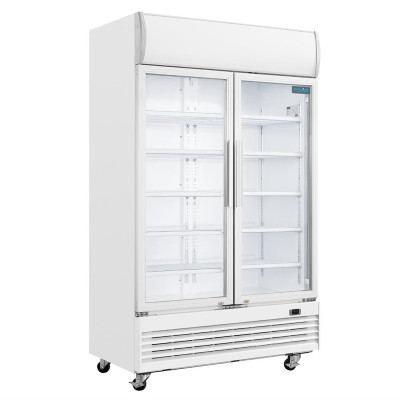
Models with upper light box, like the drinks fridge 783 litres 2 sliding doors with light box or the drinks fridge 1230 litres illuminated cabinet 2 sliding doors, offer a visible advertising space that increases marketing impact.
Snack bars, sandwich shops and chip shops are natural users: the drinks fridge presents soft drinks, water, juices and beers to the customer in self-service or near the counter. A compact 115 litres like the drinks fridge 115 litres suffices for a small snack bar.
The convenience stores, service stations and neighbourhood shops use high-capacity models: the drinks fridge 494 litres for a medium business, up to the drinks fridge 1230 litres for supermarkets. They complement the self-service wall cabinets for other fresh products.
The restaurants, brasseries and bars often integrate a drinks fridge as reserve at the back, which feeds the counter bar fridge as service progresses. For drinks to be served iced (white wines, beers), complement with an ice machine is essential.
The sports clubs, entertainment venues and events use modular drinks fridges, often on castors, to respond to demand peaks over short but intense periods.
The format depends on your daily rotation. Under 100 drinks/day, the 115-litre fridge or 382-litre fridge are suitable. Between 100 and 300 drinks/day, opt for 400-600 litres (1 glass door models). Above 300 drinks/day, 600-1200 litre double-door models become necessary.
The hinged doors are the most economical and simplest mechanically. They suit when you have space in front of the fridge. The sliding doors, as on the drinks fridge 783 litres 2 sliding doors, are indispensable in narrow spaces or high traffic: zero frontal footprint.
Models in stainless steel, like the drinks fridge 600 litres stainless steel or the drinks fridge 400 litres stainless steel, offer maximum durability and professional aesthetics. Black, white or customisable skinplate models cost less and suit standard uses.
For 360° presentation (visible from several sides), the panoramic window fridge is the premium option: ideal in the middle of a business, at the end of an aisle or as a design element in a lounge space.
The drinks fridge is the most visible equipment of your business facing customers. It directly influences sales through its showcasing capacity and service quality (drinks always at the right temperature). Some rules for buying well:
Choose a recognised professional brand, never an adapted consumer appliance. Drinks fridges operate 24/7 with dozens of daily openings: domestic models give up after 1-2 years in this context.
Check the energy class and refrigerant gas (R290 or R600a): real savings over 10 years, and guaranteed F-Gas compliance.
Think about the complete commercial ecosystem: your drinks fridge works with your bar fridges in service area, your self-service wall cabinets for other fresh products, your ice machine for iced drinks, your bar fridges for tap soft drinks and your ice machines. Equipment coherence improves service fluidity.
Finally, demand a local after-sales service in Belgium with intervention times under 48h in case of breakdown: a drinks fridge breakdown in summer immediately generates revenue loss.
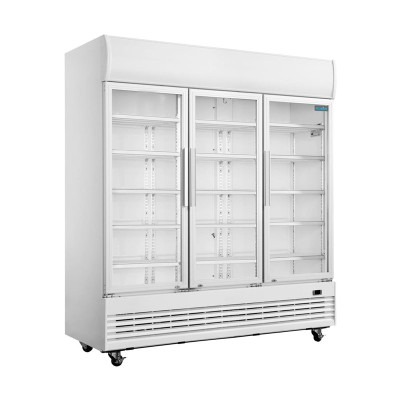
A glass-door drinks fridge does not just chill: it sells. Well lit and well placed, it triggers impulse purchases better than any poster. For a narrow counter, the 448 mm Slimline bottle cooler slips in anywhere with 300 vertical litres. For a drinks wall visible from the room, the single-door upright (307 L) and its bigger sibling the double sliding-door model (490 L) line bottles up at eye level. And when volume explodes — night shop, events hall, busy café — the 950-litre 2-door with light box or the 1300-litre 3-door display absorb the peaks without constant restocking.
Hinged doors seal better and give full access for loading — choose them when the space in front allows. Sliding doors never block the aisle: the answer for narrow corridors and service zones where an open door would obstruct. On energy, hinged keeps a slight edge thanks to its full perimeter gasket; on a unit running 24/7, that detail shows on the yearly bill.
The ideal range for drinks sits between +2 °C and +8 °C: cold enough to enjoy, mild enough not to freeze bottles near the evaporator. Load from the back and serve from the front (first in, first out), and always leave a finger of space between rows so air can circulate — a crammed drinks fridge cools its facing poorly, exactly where customers pick. In summer, plan ahead: a unit filled with room-temperature drinks takes hours to recover; top up in small regular batches rather than all at once.
A glazed drinks fridge runs continuously and its lighting draws the eye — two consumption items to manage. Useful habits: switch off the LED lighting overnight if the unit is not visible from outside, dust the condenser every two months, check the door gaskets, and never place the unit against a warm wall or in direct sun behind a shopfront. Recent models on natural refrigerant R290 use noticeably less than previous generations: if your fleet is over ten years old, replacement often pays for itself within two to three years of electricity.
A café or snack bar gets the most from a 300-litre single-door upright by the till: visible, compact, enough for the day. A night shop or convenience store should aim for 2–3 glass doors (900–1400 litres) to last the weekend without stockouts, with the light box doubling as signage. A chip shop or fast food places the unit in the queue — where impulse strikes — and favours sliding doors if the customer aisle is narrow. A caterer or event organiser goes for high capacity on castors, easy to move between storeroom and service. In every case, size up: a drinks fridge kept three-quarters full sells more and consumes less than a small saturated unit reloaded warm all day.
Like any refrigeration appliance, let the drinks fridge rest upright for four hours after delivery, then plug it into a dedicated 230 V socket. Keep 10 cm clearance around the grilles, level the unit so doors swing shut properly, and let it reach setpoint empty before first loading. For light-box models, plan access to the advertising visual: the perfect spot for your logo or this month’s promotions.
How is this different from a bar fridge? The bar fridge is low (850–900 mm) and slides under the counter; the drinks fridge is upright and faces the customer or dresses the wall. For under-counter, see our bar fridges.
Can I store fresh food in it? The +2/+8 °C range suits drinks and packaged snacks; for sensitive produce, head to our refrigerated cabinets.
Is the light box customisable? Yes, the illuminated fascia takes your own branding — free advertising space right above your drinks.