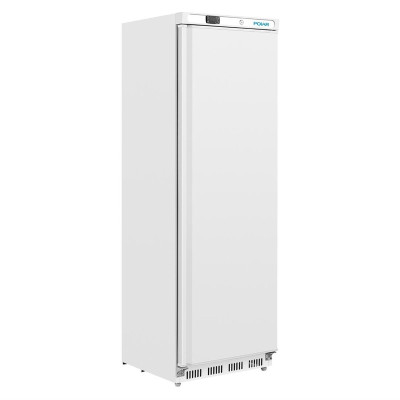

No products available yet
Stay tuned! More products will be shown here as they are added.
The professional refrigerated cabinet is undoubtedly the most structural piece of equipment in a horeca kitchen. More than just a storage unit, it shapes the organisation of work, food safety, ingredient shelf life and ultimately the profitability of your business. Restaurant, hotel, bakery, butcher's shop, caterer, pharmacy or laboratory: each profession has its own constraints, but all share the same fundamental need for reliable, high-performance and durable positive refrigeration.
At Frigo Horeca, we offer more than 40 commercial refrigerator models covering all needs of the Belgian market. From the small 400-litre cabinet for a snack bar to the 1400-litre giant for a collective kitchen, including specialised models for pastry, fishmongers or chocolate makers, you will find the right equipment for your profession. This page brings together everything you need to know to properly choose your stainless steel refrigerated cabinet, understand the differences between static and ventilated refrigeration, and optimise your investment over the long term.
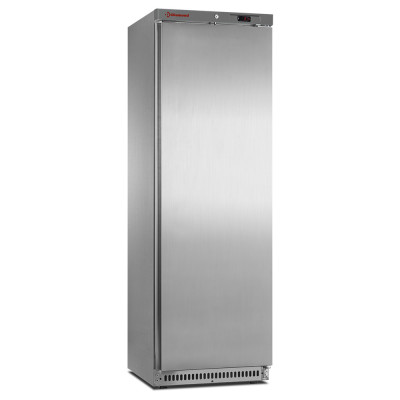
The difference between a commercial fridge cabinet and a domestic refrigerator comes down to three points: performance, robustness and compliance with professional standards. A consumer appliance is not designed for repeated door openings throughout the day, nor to withstand the ambient temperatures of a professional kitchen, nor to maintain a constant temperature under intensive load.
A professional cabinet, in contrast, is sized for intensive daily use. Its temperature recovery capacity after opening is significantly higher, its walls are better insulated (insulation thickness often above 60 mm), and its refrigeration unit is calibrated to operate in climate class 4 or 5, meaning in kitchens at 30°C or even higher.
The initial investment is higher than a consumer appliance, but the lifespan is also considerably greater: 8 to 12 years in normal use for a well-maintained professional cabinet, versus 5 to 7 years for a domestic model pushed into commercial use. Add to this HACCP compliance, adjustable feet for floor cleaning, optional door locks, and rounded corners that facilitate maintenance.
A refrigerated cabinet 600 litres or larger is the foundation of any professional kitchen. In traditional catering, it stores opened fresh products, cold preparations, desserts and drinks of the day. For a 50-cover service, a 600 to 700 litre cabinet is sufficient; beyond 100 covers, you need to consider a 1400-litre double-door cabinet or several specialised units.
In bakery and pastry, a dedicated pastry cabinet is essential. It is designed with rails for 600x400 or 600x800 mm trays and a gentle ventilated cold that preserves the texture of sensitive products. It is the natural complement to pizza saladette fridges and refrigerated tables that equip the production area.
In butcher's shops and catering, the refrigerated cabinet stores maturing meats, charcuterie, terrines and preparations. GN 2/1 ventilated models are the most versatile because they accept the large trays used for mise en place. For aged meat, specialised cabinets are also available.
In hotels, the equipment meets very varied needs: production cold storage in the kitchen, drinks storage near the bar, breakfast product preservation. Often, several cabinets are installed in different areas to optimise work flows, complementing a central cold room.
Finally, specialised sectors such as pharmacy, laboratories, chocolate making or fishmongers have cabinets designed specifically: extremely precise temperature regulation, humidity control, suitable materials. Do not underestimate the importance of a specialised cabinet for these professions where preservation is a question of quality or safety.
The first question to ask is the useful volume needed. A refrigerated cabinet 400 litres suits a small snack bar or complementary use. For a complete restaurant kitchen, count 600 to 850 litres in single door, or 1100 to 1400 litres in double door. For very large productions or central kitchens, several parallel cabinets are preferable to a single giant unit, because they allow separating use areas (meat, vegetables, preparations) and offer redundancy in case of failure.
Internal organisation also deserves your attention: height-adjustable grids, GN rails or 600x400 trays for pastry uses, hook supports for hanging meat, vertical dividers to optimise storage. Think about your real workflow before finalising your choice.
The static refrigeration relies on natural convection of cold air. It maintains high humidity, which suits fruits, vegetables and products sensitive to dehydration. The downside is that temperature distribution is less homogeneous: the bottom of the cabinet is significantly colder than the top.
The ventilated refrigeration uses a fan to circulate air, guaranteeing uniform temperature from floor to ceiling. It is the recommended choice for the vast majority of horeca uses: better temperature recovery after opening, automatic defrost, and better preservation of packaged products. Most of our models, like the refrigerated cabinet 700 litres ventilated on wheels ID70/R6, are ventilated.
For some products very sensitive to dehydration (fine charcuterie, aged cheese, fruits), a mixed ventilated/static system with humidity control like the 700-litre ventilated/static cabinet IP70PC-R2 offers an excellent compromise.
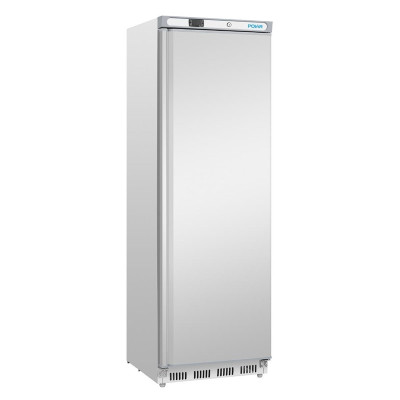
The stainless steel refrigerated cabinet AISI 304 is the professional standard: easy to clean, resistant to corrosion and impacts, with a significantly longer lifespan. All cabinets intended for direct contact with food and kitchen use must be in stainless steel.
White or grey skinplate models cost less and suit back-kitchen, storage cellar or sheltered locations. They are perfectly valid as long as the environment is not too aggressive (humidity, splashes, impacts).
For specific needs, specialised models exist: chocolate cabinet 850 litres AP1CH/F86-R2 with controlled temperature and humidity, fish refrigerator 700 litres GN 1/1 AFS1H-R2 with perforated bins and meltwater drainage, pastry cabinet Polar G Series 522L with dedicated rails, or pharmacy refrigerator with precise regulation for medicines.
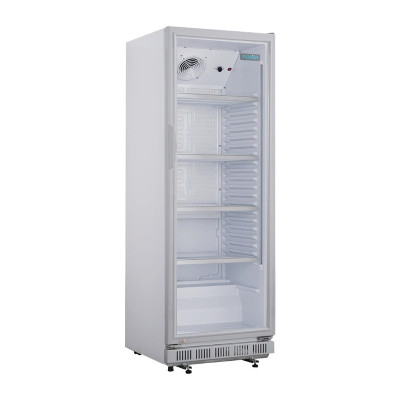
The glass door offers immediate visibility of the contents, which is precious for drinks, self-service products or to limit unnecessary openings. It consumes slightly more energy (less insulation) but improves the customer experience when the cabinet is visible. For this use, the refrigerated cabinet 700 litres glass door ID70/R6G is a popular choice.
The solid door remains the standard in back-kitchens and pure storage: better insulation, reduced consumption, and content confidentiality.
A professional refrigerated cabinet requires little installation: standard 220-240 V electrical socket, and ventilation space around the appliance (10-15 cm on the sides, more at the back for air-condensation models). Cabinets on wheels, like the refrigerated cabinet 1400 litres ventilated 2 doors on wheels ID140/R9, simplify floor cleaning and allow easy kitchen reconfiguration.
Daily maintenance comes down to cleaning door seals (a defective seal can double consumption), dusting the ventilation grille, and visual temperature checks. Every 6 to 12 months, a complete condenser cleaning and tightness check by a qualified technician significantly extends equipment lifespan.
On the energy side, prefer models in energy class D or higher with ecological refrigerant gas R290 or R600a: lower consumption, lower environmental impact, and compliance with the European F-Gas regulation in force.
For a service of 50 to 100 covers, a ventilated 600 to 850 litre cabinet is ideal. If you have a lot of mise en place, opt for a GN 2/1 format or with rails for 600x400 trays. For very large volumes, two separate cabinets (one for everyday cold, one for sensitive products or meat) are better than a single unit.
Pastry cabinets in 600x800 or 600x400 format are essential. The ventilated cabinet 40x EN 600x400 or 20x EN 600x800 AP1N/F86-R2 is designed specifically for these professions. For high-end pastry, the Polar G Series 522L pastry cabinet provides a very gentle cold that preserves textures.
For a hotel or canteen kitchen, several specialised cabinets per area (starters, mains, desserts, drinks) are more efficient than one large single cabinet. 1100 to 1400 litre double-door models cover mise en place needs, possibly complementing a cold room for main stocks.
Opt for a stainless steel cabinet with rails suitable for gastronomic trays and, ideally, a humidity control system to preserve meat quality. For ageing, specific cabinets exist. The fish refrigerator is essential in fishmongers or specialised seafood catering.
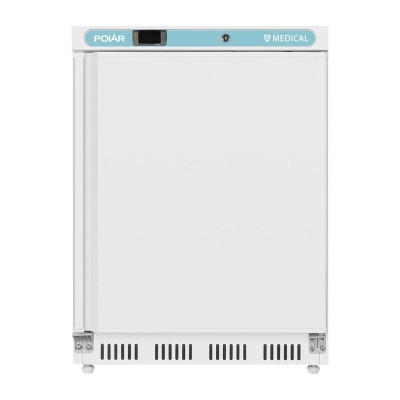
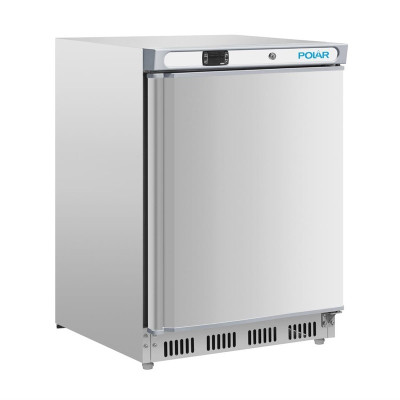
For the preservation of medicines or sensitive products, dedicated models with precise regulation like the Polar 128 L under-counter pharmacy refrigerator meet the regulatory requirements of the pharmaceutical cold chain.
Our catalogue covers all needs, with recognised brands (Polar, True, Diamond, and professional series):
The refrigerated cabinet is the equipment that must accompany you longest in the kitchen — 8 to 12 years minimum if well chosen. A few rules secure this structural investment.
Always prefer a recognised brand from the professional sector (Polar, True, Diamond, and other established horeca references). Spare parts available over 10 years and a local after-sales network are essential: a cabinet broken down in the middle of a holiday service is a logistical nightmare.
Check the announced climate class. A class 4 cabinet (ambient T° up to 30°C) suffices for most Belgian kitchens, but if your kitchen regularly rises above that, opt for class 5 (up to 40°C) which will maintain the target temperature without overconsumption.
Think about the complete cold ecosystem: your refrigerated cabinet works as a team with your freezer cabinets, your refrigerated tables, your display counters and possibly your cold room. The coherence of this ecosystem (same GN tray sizes, compatible brands, complementary temperatures) greatly facilitates daily work and maintenance.
Finally, never neglect after-sales service and warranty. An average quality product with a responsive local after-sales service will always be preferable to a high-end imported product without local support. This is one of the major criteria that distinguish serious suppliers.