

No products available yet

Stay tuned! More products will be shown here as they are added.

Refrigerated saladettes and pizza prep counters: the complete guide

The refrigerated saladette is the ultimate assembly station: an open chilled well that keeps your filled GN pans at the legally required temperature, right under the preparer's hands. Sandwich shops, salad bars, kebab houses, pizzerias, snack bars: wherever dishes are composed to order, a saladette saves precious seconds on every ticket while protecting the cold chain. At Frigo Horeca we stock a full range of countertop saladettes and saladette fridges with refrigerated bases from the Diamond, Diverso and Polar catalogues. This guide helps you pick the right model for your business in Belgium.

Countertop saladette or saladette fridge: what is the difference?

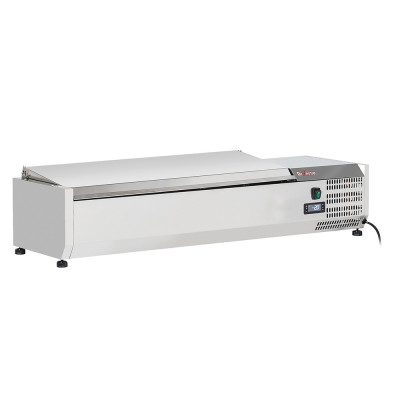
The countertop saladette is a compact module that sits on an existing worktop or cabinet: the most economical way to add a cold topping station without refitting the kitchen. The 8× GN 1/6 countertop saladette fits in under 95 cm, while the 7× GN 1/3 version and the large GN 1/1 saladette hold more pans for richer menus. The saladette fridge combines the topping well with a refrigerated cabinet underneath, like the 1200 mm glass-top pizza salad fridge: refills are stored right at the station, which means no more trips to the cold room mid-rush.

Glass guard, stainless lid or open well: protecting the toppings

The right top depends on your exposure. A glass sneeze guard is a must as soon as customers can see the station (counter sales, open kitchen): it protects the food while keeping it on display, a real selling point for a kebab shop or salad bar. A stainless steel lid, as on the 1200 mm saladette with cover or the long 2000 mm model, seals the well outside service hours: temperatures hold better overnight and consumption drops. Premium units such as the 12× GN 1/4 saladette with straight glass combine large capacity with a polished presentation.

Understanding GN pans: the key to sizing

Saladette capacity is expressed in Gastronorm pans: GN 1/1 (530 × 325 mm), 1/3, 1/4, 1/6, 1/9… The smaller the fraction, the more different toppings fit on the same length. Count the ingredients on your menu: a sandwich shop running 12 toppings needs a 12× GN 1/4 or 8× GN 1/6 well; a pizzeria with 8 to 10 condiments will manage with a 7× GN 1/3 rail. Also consider pan depth (H100 or H150 mm): shallow pans replaced more often beat deep pans where product spoils at the bottom.

Full-length glass saladettes for visual concepts

Where presentation drives sales, the full-length glass saladettes of the Diamond Platinum range, like the 1400 mm glass saladette or the long 2000 mm version, offer a low refrigerated display above a complete cold base. This is the signature equipment of poke bowl bars, pasta bars and premium sandwich concepts where customers build their dish along the rail.

Need a full pizza counter? Head to refrigerated counters

If a topping rail alone is not enough and you need a complete station with granite top and refrigerated base, pizza counters live in our refrigerated counters category. The pizza counter is the saladette’s specialist cousin: a granite worktop that stays cool and never sticks to the dough, a refrigerated base for dough balls and a filled GN rail on top. The ventilated 2-door 1650 mm pizza counter covers pizzerias up to 60 covers; the 3-door 2050 mm version adds the storage needed for high output, and the 1850 mm model with drawers makes proofing dough management easier. On the Diverso side, the 3-door pizza table with splashback offers excellent value. Pair it with a good pizza oven and your production line is complete.

Ventilated or static cooling for a saladette?

The top well of a saladette generally uses gentle static cooling (it holds pans that are already cold), while the base cabinet of recent models is fan-assisted to cope with repeated door openings. In practice: for continuous service, choose a ventilated base — nearly all our Diamond and Diverso models have one. Use the cooling-type filter on this page to compare. And remember the golden rule: a saladette holds the cold, it does not chill. Always load pans straight from your refrigerated cabinet, never room-temperature product.

Temperatures, hygiene and food safety

Our saladette wells typically run between +2 °C and +10 °C, the right range for vegetables, cold cuts and cheeses in service. The Belgian food agency (FAVV/AFSCA) requires sensitive goods to stay below +7 °C: watch the digital display and log readings in your HACCP plan. For hygiene, favour models with removable pans and rounded-corner wells, much faster to clean after service. All our units are food-grade stainless steel and CE compliant; sneeze guards meet counter-sale requirements.

Which saladette for which business?

A food truck or small snack bar will pick a compact countertop saladette on a standard 230 V plug. A steady sandwich shop should step up to a 1200–1400 mm saladette fridge with built-in storage. A customer-facing kebab or salad bar will want a full glass front, like the entry-level Polar 240 L saladette counter. A pizzeria should go straight to a granite pizza counter sized to output: 2 doors up to 60 covers, 3 doors beyond. In every case, check the available counter length and door swing before ordering.

How much does a professional saladette cost?

Countertop saladettes start around 400 to 700 euros: the fastest payback of any kitchen investment. Complete saladette fridges run from 900 to 2,000 euros depending on length and top type, and granite pizza counters from 1,500 to 3,000 euros. The gaps come from cooling technology (ventilated versus static), steel grade and accessories (glass guards, dough drawers, splashbacks). Watch the permanent discounts on the Diamond Platinum range, shown with crossed-out prices on the product pages.

Buying mistakes to avoid

First: undersizing the well. A rail that is too short needs constant refilling and ends up overflowing onto the worktop; always plan one or two pans more than your current menu. Second: ignoring the working environment. A saladette facing an oven door or in direct sunlight will drift above legal temperatures, whatever its quality. Third: forgetting working height — a countertop unit adds 25 to 30 cm to the existing surface; make sure the station stays ergonomic. Fourth: choosing a model without removable pans or with sharp internal corners, which turns every closing clean-down into a chore. Finally, beware of non-standard wells that reject standard GN pans: proprietary pans cost dearly over the years.

Saladettes and kitchen workflow

In a professional kitchen the saladette is the last step of the forward flow: products arrive washed, cut and panned, and only leave plated or in the bread. Arrange the rail in the order your recipes are built, first ingredient to last: the gesture becomes automatic and service speeds up. Keep one pan at the end of the rail for sauces and place the most sensitive products (meat, fish) in the centre of the well where cooling is most even. This simple layout reduces order errors, limits cross-contamination and makes hygiene inspections easier.

Keeping energy use under control

A saladette draws little power — often under 0.25 kW — but good habits still pay. Cover the well whenever service slows: one covered hour a day saves dozens of compressor hours a year. Clean the condenser every two months, replace tired gaskets, and set the thermostat to the temperature you actually need rather than the minimum. When buying, favour recent refrigerants (R290, R600a): they use 15 to 20 percent less energy at equal power.

Complete your cold line

The saladette is one link in a full chain: professional refrigerated counters for prep stations, blast chillers to bring house preparations down to temperature, display counters for front-of-house sales and ice machines for the bar. A coherent cold line cuts walking distance and waste.

Why buy from Frigo Horeca?

A horeca store based in Brussels, Frigo Horeca works directly with Diamond and its Diverso line, the references of the Belgian market, plus Polar for entry-level equipment. Our stock is synchronised daily with the manufacturers, every product page lists dimensions, temperatures and power, and our team advises you in English, French or Dutch. Fast delivery across Brussels, Wallonia and Flanders.

Pans, lids and accessories worth adding

A saladette is only as efficient as its pans. Polycarbonate pans are lighter and show the contents at a glance, while stainless GN pans last longer and tolerate the dishwasher better; many kitchens mix both, stainless for proteins and polycarbonate for vegetables and sauces. Add hinged or notched lids for the pans you use less often, so they stay covered between orders without slowing service. Spare gaskets, a probe thermometer to double-check the display, and a dedicated cutting board that clips to the front edge complete the station. If you compose hot-and-cold dishes, keep the hot section physically separate: steam rising into the well forces the compressor to work overtime and fogs up glass guards.

From delivery to first service: a quick checklist

Let the unit stand upright for four hours after delivery so the refrigerant settles, then level it and plug it into a dedicated socket. Run the well empty until it reaches set temperature, which takes one to two hours, before loading pre-chilled pans. Check the door swing of the base cabinet and the position of the drain before fixing the final location. Record the operating temperature in your HACCP log from day one: it gives you a baseline to detect any drift of the cooling unit later, and inspectors will ask for it. Finally, train the team on the closing routine — empty, film, store, cover — because the few minutes spent each evening are what keep a saladette compliant and durable for years.

Cleaning routine that keeps you compliant

Daily: empty the well, wash pans and lids, wipe the well and rails with food-safe sanitiser, and leave the lid open to air-dry. Weekly: pull the pans out completely, clean the pan supports and the drain hole, and wash the glass guard on both sides. Monthly: vacuum the condenser grille and check that the door gaskets of the base cabinet still grip a sheet of paper. This thirty-minute monthly routine is the single best predictor of how long your saladette will last — and it is exactly what hygiene inspectors like to see written into your cleaning plan.

Frequently asked questions

Can a saladette chill warm products? No: it holds pre-chilled pans at temperature. Cool your preparations in a blast chiller first, then load the well.

What is the difference between a saladette and a pizza counter? The pizza counter adds a granite worktop for dough work and often dough drawers; the topping rail works on the same principle.

Are GN pans included? It depends on the model: the product page lists what is supplied. Standard GN pans are easy to source as accessories in every fraction and depth.

Can I leave the saladette on overnight? Yes for the base cabinet; for the well, follow the manual: most manufacturers recommend emptying it, covering and either running empty or switching off depending on the model.

This website uses cookies to ensure you get the best experience on our website