No products available yet
Stay tuned! More products will be shown here as they are added.
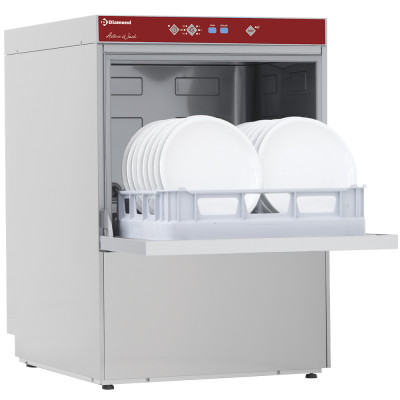
Utensil dishwashers are reinforced washing machines designed to handle what standard dishwashers struggle with: pots, baking trays, gastronorm containers, plates and bulky utensils. Deeper and fitted with suitable racks, they take over in production kitchens where a simple dishwasher for glasses and plates reaches its limits. Frigo Horeca offers a selection of Diamond models built for this demanding washing.
A utensil dishwasher combines the speed of a professional dishwasher with the capacity needed for kitchen containers. Its tank and racks accept tall and wide items: oven trays, GN containers, pots, trays. Washing relies on hot water and a high-temperature rinse, ensuring a hygienic result and rapid drying, even on utensils heavily soiled by cooking.
Where a classic front-loading dishwasher is optimised for 500×500 mm racks of plates and glasses, the utensil dishwasher favours depth and robustness. It accepts 500×600 mm racks and 600×400 mm plate trays, formats suited to kitchen containers. Its washing mechanics are sized to lift baked-on soiling, more stubborn than table residues.
The rack format determines what the machine can hold. The 03D/6S model offers 600×400 mm plate trays and 500×600 mm racks, while the 03D/6H is dedicated to the 500×600 mm rack. These standardised formats allow specific racks depending on the items to wash: containers, lids, trays or long utensils.
Like all washing equipment, the utensil dishwasher suffers from limescale. The DFS7/6-AC versions integrate a continuous softener that treats the water permanently, protecting the heating elements and guaranteeing deposit-free utensils. When the machine has none, installing a water softener upstream remains the best protection against scaling.
For a standalone installation, sets with a base unit offer a comfortable working height and storage space. The closed-base model protects storage from dust and splashes, while the open-base model eases access and ventilation. The choice depends on the kitchen's organisation and the type of items stored underneath.
Like other professional dishwashers, these machines come in 230 V single-phase or 400 V three-phase versions. Three-phase offers a faster temperature rise, useful for chaining utensil racks in a production kitchen, but requires a suitable installation. Check compatibility with your electrical panel before buying; if in doubt, our team will guide you.
The high-temperature rinse ensures impeccable hygiene of utensils, a critical point in production kitchens where containers move from raw to cooked. Mechanised washing guarantees a consistency that manual washing cannot achieve, and towel-free drying limits recontamination. These machines fit naturally into an HACCP approach.
The choice depends on the volume of utensils, the formats to wash and the available space. For tableware and glasses, stick with a standard dishwasher or a glasswasher; for pots, trays and GN containers, the utensil dishwasher is essential. For very high throughput, a hood-type model can complete the installation.
Connection to water, drainage and the electrical network must be carried out according to the machine's power. Three-phase models require a dedicated 400 V line. We recommend commissioning by a qualified installer, who will set the water hardness and check the correct operation of the whole, in compliance with electrical and sanitary standards.
Draining and cleaning the tank after service, checking the wash arms, cleaning the filters and periodic descaling according to water hardness: regular maintenance keeps short cycles and effective rinsing. Using softened water and correct product dosing greatly reduces scaling and extends the appliance's life.
Manually washing pots, trays and containers ties up staff for long minutes, with an irregular result and high hot-water consumption. Mechanising this task frees up working time, guarantees consistent hygiene and reduces the risk of burns and musculoskeletal problems linked to scrubbing. In a production kitchen, the utensil dishwasher quickly becomes essential: it absorbs peaks of dirty ware during and after service, without tying a commis to the sink. Over time, the productivity gain and hygiene consistency far outweigh the initial investment.
Professional kitchens are now organised around the gastronorm (GN) standard, which normalises the dimensions of containers, trays and pans. A utensil dishwasher able to accept these formats simplifies the whole chain: containers go from the cold room to the oven, then to washing, without transferring. The 500×600 mm racks and 600×400 mm plate trays accept most common containers, making the machine a coherent link between the washing area and the cooking and storage stations.
Like any professional dishwasher, these machines offer short cycles, often selectable according to the degree of soiling. For utensils heavily soiled by cooking, a longer cycle and well-heated water deal with carbonised residues. The ability to chain racks determines productivity: the more containers the machine processes per hour, the more fluid the kitchen stays. Correctly sizing throughput to production volume avoids the build-up of dirty utensils at critical moments.
Mechanised washing controls water consumption better than manual scrubbing at the sink, while ensuring better hygiene. The rinse uses a controlled volume of water, partly reused for the wash tank. The main source of overconsumption remains limescale: a scaled heating element heats for longer. Pairing the machine with softened water and respecting product dosing stabilise running costs, a real issue for a kitchen operating daily.
These machines are built from stainless steel, inside and out. Stainless withstands constant humidity, heat and cleaning products, and absorbs the knocks of heavy containers handled daily. Its smooth, non-porous surfaces are easy to clean and disinfect, supporting good hygiene practice. It is this construction that allows a utensil dishwasher to endure intensive use for years, where a consumer appliance would quickly give way.
The right rack protects items and optimises washing. Depending on the utensils, you choose open racks for containers and trays, supports to hold lids or trays upright, or versatile racks. Well-planned loading lets water circulate around each item and avoids poorly rinsed shadow zones. Washing accessories complete the installation, from dosers to inlet and outlet tables to organise the flow.
Manually scrubbing heavy, soiled utensils is hard and hazardous: scalding water, repetitive movements, risk of cuts on metal edges. Entrusting this work to the machine clearly improves staff conditions and reduces downtime linked to musculoskeletal problems. Sets with a base unit also place the loading zone at a good height, limiting repeated back bending. A well-designed washing station means a safer kitchen and staff who tire less over the course of service.
The utensil dishwasher comes into its own when it fits into an organised wash area. Upstream, a prewash table with bowl and waste hole clears the largest residues; downstream, an outlet table allows draining before storage. Washing accessories and an upstream softener complete a coherent set. Designed as a continuous line, from sorting to storage, the wash area gains fluidity and the utensil dishwasher naturally finds its place.
In a production kitchen, the same containers often move between raw preparation, cooking and service. This back-and-forth makes thorough washing of utensils between uses a key point of food safety: a poorly cleaned container can carry residues and bacteria from one stage to the next. The high-temperature rinse of a utensil dishwasher provides a level of cleaning and disinfection that manual washing struggles to match consistently. Combined with towel-free drying and removable, easy-clean filters, it gives the kitchen a reliable, traceable washing step that supports HACCP requirements day after day, even when the pace of service leaves little time for manual care.
What is the difference from a classic dishwasher?
The utensil dishwasher accepts taller and wider items (pots, trays, GN containers) thanks to 500×600 mm racks and 600×400 mm plate trays, and mechanics suited to baked-on soiling.
Can it wash tableware?
Yes, but for large volumes of glasses and plates, a standard dishwasher or a dedicated glasswasher remains more suitable.
What does the continuous softener add?
It treats the water permanently to prevent limescale from depositing, protecting the heating elements and guaranteeing mark-free utensils.
Open or closed base unit?
The closed one protects storage from dust; the open one eases access and ventilation. The choice depends on your organisation.
230 V or 400 V?
400 V three-phase heats faster and suits high cadences; 230 V is enough for more moderate use.
Do I need an installer?
We recommend it, especially for three-phase models and setting the water hardness.
Can it handle gastronorm containers?
Yes. The 500×600 mm racks and 600×400 mm plate trays are sized for most common GN containers, lids and oven trays used in production kitchens.
Explore the full Washing range and accessories from Frigo Horeca.